2026 Blog Business Plan
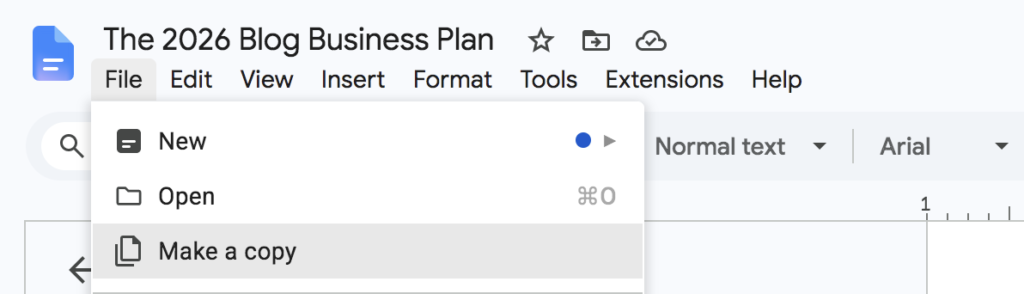
Creating a blog business plan before you start writing posts is a critical step to ensure success of your blog. To get started, click on the link to get your own Google Doc worksheet.
2026 Blog Business Plan Google Doc Worksheet.
Simply make a copy of the document, and fill in the requested information to get your blog business plan rolling.
Executive Summary
An executive summary is a concise overview of your business plan. It highlights the key points in order to helps busy professionals get the overall message without having to read the entire document.
- Independent document – The message should be clear. Include a summary of the full content and conclusions. It should make sense without having to read the rest of the business plan.
- Length – Most executive summaries are about 5 – 10% of the business plan, and are usually 1 – 2 pages long.
- Need to know information – Includes all necessary information needed to understand and act on the final project and goals.
- Written last Even though the executive summary sits at the front of your business plan, it’s written last in order to summarize and include the correct data.
To sum things up, the executive summary should be a snapshot that provides all the necessary information in order to succeed. Your blog business plan’s executive summary should be written AFTER you complete your blog business plan (even though we are listing it first, it should be written last).
Mission Statement
A mission statement is a brief dictation that explains your blog’s purpose in the present. It’s generally one or two sentences long and is composed of three parts:
- What do you do? The products or services you provide
- How do you do it? The methods and strategy you plan on using to serve your target market
- Why you exist – Your core purpose
Mission Statement Examples
Here’s a few mission statements that answer the who, how, and why’s.
Amazon’s official mission statement is “to be Earth’s Most Customer-Centric Company, Earth’s Best Employer, and Earth’s Safest Place to Work.”
𝕏’s official mission statement, “to promote and protect the public conversation — to be the town square of the internet.”
Google’s official mission statement is “to organize the world’s information and make it universally accessible and useful
Vision Statement
A vision statement is a brief dictation that explains your blog’s future. It’s generally one or two sentences long.
- Where do you see your blog in 5 – 10 years from now?
- What core values are you bringing into the world?
- Keep it simple – Where are you going, and how will you get there?
Vision Statement Examples
Here’s a few mission statements that answer the who, how, and why’s.
Amazon’s official vision statement is to be Earth’s most customer-centric company; to build a place where people can come to find and discover anything they might want to buy online.”
𝕏’s official vision statement is”to be the ultimate ‘everything app’ that revolves around audio, video, messaging, payments, and banking and is powered by artificial intelligence.
Google’s vision statement is “to provide access to the world’s information in one click”
Products & Services
When blogging, the service offered is your writing. Whether it be an educational how-to post, an political editorial, a fictional piece, or a product review page – your job as a blogger is to create content and provide solutions to your readers. Google search bar is filled with questions waiting to be answered by bloggers like you. Take a minute to pull up Google, and type your niche keyword in, and see what people are searching for.
Tsdhe products you are selling may be your own, or you may be affiliated with another company, such as Amazon.
Questions to answer:
- What products or services are you selling?
- Who are you affiliated with?
- What type of monetization efforts are you planning on using?
- What are your short-term and long-term goals?
Step 1: Market Analysis
A market analysis is a snapshot of a specific business sector and its customers. It helps you see if a product or service can be successful before investing.
Key Components
- Industry Overview: Looks at the overall size, growth rate, and trends of the market.
- Target Audience: Find the ideal customer and build a buyer persona including the demographics of your ideal audience.
- Market Size and Projections: How much money does your industry earn annually? Is it possible to earn a percentage of the sales? How many people buy this product
- Ask yourself, “Is it possible I can make X amount of money in this industry by selling .01% of the money market.
Target Market
Target market is a large group of all possible customers for a brand or product. The data for your target market is called “demographics.”
- Age: How old is your target market?
- Gender: Male or Female
- Income: How much money does your buyer persona have?
- Race and Ethnicity: The cultural or racial groups people belong to.
- Education: The highest level of school a person finished.
- Location: Where people live, such as cities or rural towns.
When building out demographics, it’s a great idea to create a few buyer profiles that represent your ideal target market. Read more about buyer personas here.
Target Audience
A target audience is a smaller group of people within the target market that you are trying to reach. For example, your blog niche may be “exercise for the elderly. But you find an untapped niche in “water aerobics for elderly.” Doing this helps you create content your readers are searching for.
Market Trends
Market trends are the general direction in which a particular market moves over time.
- Uptrend (Bull Market): Prices move upward in a growing market
- Downtrend (Bear Market): Prices or sales go down over time
- Consumer and Business Trends: How buyer habits, technology, or new demographics change due to technology or other reasons.
Keyword Analysis
But before you jump right in to creating content, take some time to research keywords and keyword phrases. You can check out SEMRUSH for keyword research – they offer a free 7 day trial for new customers.
But why do you need to do this?
If you don’t do keyword research before you start writing your posts, you are missing out on tons of chances to optimize your posts. Search Engine Optimization is how your blog will find it’s way into Google & Bing. You may also end up writing about topics that have a very low monthly search rate, resulting in wasted energy that could have gone towards writing a more profitable post.
Step 2: Blog Description
Blog Title
A great blog title is concise and clear. Keep it limited to less than 60 characters to avoid it being cutoff in the search engines.
- Keep it short: Aim for 50 to 60 characters so search engines do not cut it off.
- Add keywords: Include your main keywords when possible.
Blog meta description
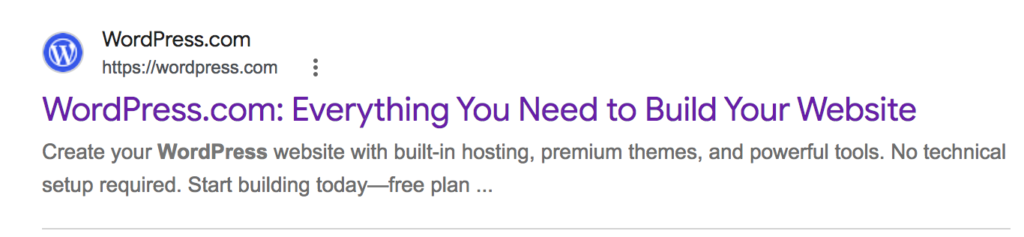
A blog description is the text that shows up in search engines after the website name. It tells visitors what your blog is about. It is generally 140 – 160 characters, and should include one of your main niche keyword phrases.
Here is what an example of a blog description looks like.
Step 3: Competitor Analysis
What is a competitor analysis?
A competitor analysis is an in-depth report of your direct & indirect competitors. It includes their strengths, weaknesses, pricing, marketing strategy, social media outreach, and overall customer satisfaction.
Direct Competitors
Direct competitors offer the same product or service. They solve the same problems as you.
Indirect Competitors
Indirect competitors offer a different product, but it still solves the same problem.
- Products and Services: What types of products are being offered? What are the product features, prices, and what problem do they solve.
- Goals – Identify your competitors long-term and short-term goals.
- Marketing and Sales:
How does your competitor promote their products & services?
What is the price range?
What is the quality of the product?
- Customer Experience: What rating does your competitor carry
- Market Position: Determine their target audience, market share, and brand reputation.
Step 4: Products & Services
As a blogger, the service you are offering is the ability to provide relevant information in a readable format to your target audience. And in order to monetize your content, you may find yourself reviewing products and services for affiliation sales.
- Product or service descriptions – Explain the products or services you are offering
- Benefits – What are the pros of choosing your blog? How will you help me find a solution?
- Pricing – How much does it cost?
- Competitive Advantage – A strategy that helps a business outperform it’s competition.
Step 5: Marketing and Promotion
Step 6: Funding Needs
How much does it cost to start a blog?
It can cost anywhere from $0 – $1,000+, depending on a variety of factors.
Include:
- Yearly domain registration – This can fluctuate, with most .com’s averaging about $20/year. This price can increase dramatically if you want a different extension (.ai, .tech, etc)
- Hosting – Ranges anywhere from $5/month – $300/year based on your hosting provider.
- Stock photos
- Email marketing service – such as Aweber start at $20/month
- Outsourcing projects (such as graphic design for infographics, blog customization, article writing, etc.) Price varies.
If you want to make money blogging, you’re going to need an audience. Your audience may find their way to your site via several different avenues. Here, we are going to cover some of the basics.
- Search Engine Optimization – Get listed in Google, Yahoo, and Bing by following these best practices. Use Google and type a keyword into the search bar and see what pops up to find popular searches.
- Social Media – Build profiles on 𝕏, Facebook, Instagram, & Pinterest. Host giveaways to encourage shares.
- Incorporating Graphics – Build custom ads with software like Adobe Express to share on social media.
- Youtube – Make videos to connect with your audience.
- Word of mouth – Share with your friends, family, and business associates.
- EDDM (Every door direct mail )- Create a flyer and reach 1000’s. Great to use if your blog is local. Check with your USPS about EDDM services.